
 Delete Article!
-
082024. 08
No. 210 View. 117556
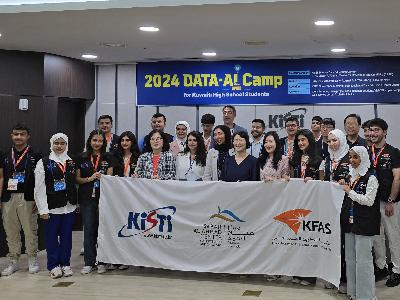
KISTI Hosts 2024 DATA·AI Camp for Kuwaiti High School Students
KISTI Hosts 2024 DATA·AI Camp for Kuwaiti High School Students - Enhancing Kuwaiti Youth’s Understanding of AI Technology and Promoting International Scientific Exchange - The Korea Institute of Science and Technology Information (KISTI, President Kim Jae-soo), in collaboration with the Kuwait Foundation for the Advancement of Sciences (KFAS), chaired by H. H. The Crown Prince Sheikh Meshal Al-Ahmad Al-Jaber Al-Sabah, hosted the "DATA·AI Camp for Kuwaiti High School Students" from July 31 to August 5, 2024. This camp, held for the third consecutive year since 2022, is designed to enhance Kuwaiti youth’s understanding of AI technology and promote international scientific exchange and cooperation. It achieved this through KISTI’s expert-led sessions and visits to its advanced infrastructure. The camp featured topics such as ▲ understanding the Fourth Industrial Revolution, ▲ programming through AI chatbots, and ▲ computational thinking team projects. A total of 16 Kuwaiti high school students participated in this year’s camp. Participants engaged in various activities, including, ▲ touring the Computing and Advanced Visualization Environment (CAVE), ▲ visiting the National Supercomputing Center, ▲ practicing with VlabON, an online math and science platform, ▲ utilizing the MyKSC web service portal for supercomputing. Students also participated in hands-on exercises involving supercomputers and modeling/simulation practices, experiencing firsthand KISTI’s advanced infrastructure. Building on the program’s success over the past three years, KISTI and KFAS signed an MOU in February 2024 to deepen their collaboration. This agreement focuses on ▲ conducting joint research to enhance digital capabilities and ▲ fostering future professionals through educational cooperation. Kim Ji-young, Director of KISTI’s Science Data Education Center, remarked, “This year’s camp marked the first event following the MOU between KISTI and KFAS. We tailored the program to provide students with extensive exposure to Korea’s advanced scientific platforms and culture. By emphasizing hands-on, team-based projects, we encouraged students to take a proactive approach to problem-solving. We hope this experience inspires Kuwaiti students to grow into global scientific leaders who will drive the Fourth Industrial Revolution.” The Science Data Education Center at KISTI develops and operates specialized educational programs for professionals across industries, academia, research institutions and government, as well as for future talent. These programs leverage KISTI’s expertise in scientific data, supercomputing infrastructure, and data science. * Scientific Data Education Center website: https://kacademy.kisti.re.kr/ -
312024. 07
No. 209 View. 121838
KISTI Unveils New Version of KONI, Science and Technology-Specialized Generative...
KISTI Unveils New Version of KONI, Science and Technology-Specialized Generative Large Language Model - Expectation for Accelerating Innovation in Scientific Research through Large-Scale Training Data and RAG Technology - The Korea Institute of Science and Technology Information (KISTI, President Kim Jae-soo) announced on July 31 the release of a new version of its science and technology-specialized generative large language model (LLM), KONI (KISTI Open Natural Intelligence). The new version of KONI offers significantly enhanced performance compared to the original model developed in December of last year and is now publicly available for anyone working in science and technology fields to use. As a national research institute specializing in science and technology information, KISTI continues to lead the development of LLMs specialized in science and technology by consistently collecting and analyzing various national science and technology big data. The newly released version of KONI is available in two models: KONI-Llama3-8B (pre-trained LLM) and KONI-Llama3-8B-Instruct (Chat model). The newly released models were trained with data containing over twice the amount of science and technology information compared to previous models, significantly improving performance in various tasks such as reasoning, writing, and comprehension. Notably, KONI achieved the top rank in the LogicKor benchmark leaderboard (https://lk.instruct.kr/) for comprehensive reasoning ability in Korean LLMs of the same size. KONI LLM, with a model size of just 8B, surpassed a LogicKor score of 8 points, reaching 8.21 points, setting a new milestone in Korean LLM development. KISTI KONI LLMs are available for unrestricted download and use through Hugging Face (https://huggingface.co/KISTI-KONI) and KISTI's AI Data Sharing and Utilization Service AIDA (https://aida.kisti.re.kr/). Additionally, KISTI has developed Retrieval-Augmented Generation (RAG) technology, utilizing data from existing information service systems to minimize hallucination phenomena typically occurring in LLMs. By integrating RAG technology with KONI, KISTI has developed a more reliable question-answering system. Performance verification and additional training based on feedback from researchers have further improved KONI's capabilities, particularly in the domain of science and technology-related laws, regulations, and guidelines. Moving forward, KISTI plans to continuously collect national science and technology data and periodically release new versions of KONI in various model sizes with enhanced performance. KISTI will also develop and distribute domain-specific LLMs reflecting the needs of public institutions in sectors such as defense, energy, and policy, as well as national research institutions. KISTI President Kim Jae-soo stated, “With the new version of KONI, we plan to revolutionize the distribution and analysis systems of science and technology information across various fields, including science, technology, and industry, and ultimately build an autonomous AI researcher—an AI Agent framework based on KONI—to support scientific discoveries.” -
132024. 06
No. 208 View. 101075
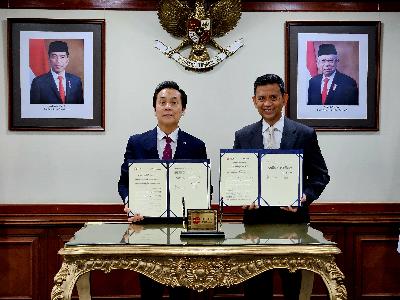
KISTI Signs MOU with the Indonesian National Research and Innovation Agency (BRI...
KISTI Signs MOU with the Indonesian National Research and Innovation Agency (BRIN) to Build S&T Data Infrastructure - Establishing a Foundation for Collaborative Research on the Utilization of S&T Data through HPC Infrastructure and NTIS Development - The Korea Institute of Science and Technology Information (KISTI, President Kim Jae-soo) announced that on June 12, it signed a Memorandum of Understanding (MOU) with the Indonesian National Research and Innovation Agency (Badan Riset dan Inovasi Nasional, BRIN) in Indonesia to jointly build science and technology data infrastructure. * BRIN was established in 2021 by merging several national research institutions in Indonesia. It is an independent agency directly under the President, with the authority to plan national research and development policies and allocate budgets to support Indonesia's research and innovation. Through this MOU, KISTI and BRIN have laid the groundwork for collaborative research on the utilization of science and technology data, which includes ▲ research on the establishment and utilization of science and technology knowledge infrastructure, ▲ research on the development and utilization of supercomputing/HPC infrastructure, ▲ research on big data, AI, and computing technologies, including data exchange, ▲ development and utilization of scientific research networks and cybersecurity, and ▲ collaboration on human resources, equipment, data, and other related resources. Laksana Tri Handoko, Head of the Indonesian National Research and Innovation Agency, stated, “Through this MOU with KISTI, we have gained an opportunity to learn data utilization know-how, including supercomputing and NTIS operation. I hope this will be a stepping stone to further enhance Indonesia's scientific and technological competitiveness.” KISTI President Kim Jae-soo remarked, “This MOU will serve as a foundation for science and technology collaboration with Indonesia through the expansion of KISTI's research and development capabilities in science and technology data, based on KISTI’s supercomputing infrastructure and NTIS development and operation technologies. It will also present a new opportunity to elevate South Korea's scientific and technological stature on the global stage.” -
032024. 04
No. 207 View. 92329
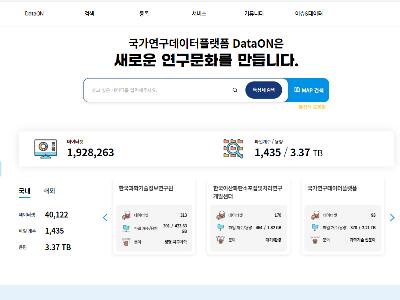
KISTI Obtains Korea's First Core Trust Seal International Certification
KISTI Obtains Korea's First Core Trust Seal International Certification - KISTI anticipates systematic management and ecosystem development for national research data - The Korea Institute of Science and Technology Information (KISTI, President Kim Jae-soo) announced that it has obtained the Core Trust Seal (CTS) certification, marking the first time in Korea that a research data repository has been accredited for its reliability. The CTS certification, issued jointly by the World Data System (WDS) under the International Science Council (ISC) and the Data Seal of Approval (DSA), guarantees that a repository is a “trustworthy research data repository.” The certification ensures that the research data repository adheres to high standards of reliability and management. CTS certification evaluates the reliability of a research data repository’s systematic management policies and systems. Globally, only 107 research data repositories (out of more than 3,000 listed on the re3data* repository search site) have obtained the CTS certification. The certification process involves assessing 16 key criteria, which are prerequisites for a research data repository, including the repository’s stability, mission appropriateness, technical and organizational infrastructure, data preservation, quality, access, licensing, search, citation, and evaluation. Each criterion must be met for the certification to be granted. * research data search engine The KISTI DataON platform, which recently received the CTS certification, is a national research data platform that supports data-driven research activities such as the collection, storage, search, analysis, and utilization of research data. Since its launch in January 2020, DataON has provided research data repositories to domestic and international institutions, currently securing approximately 1.92 million research datasets for use by researchers. DataON supports individual researchers, project teams upon project completion, and researchers submitting to data journals by helping them register research data that they may find difficult to preserve. Additionally, with the legislative push for the 「National Research Data Management and Utilization Promotion Act」, the importance of DataON is expected to grow. KISTI President Kim Jae-soo stated, “With the first-ever CTS certification in Korea, KISTI is expected to play a leading role in establishing a national research data management system, while building the necessary infrastructure and ecosystem for research data management.” He also added, “Through DataON, KISTI plans to share and disseminate research data management expertise with government-funded research institutions, universities, and national research institutes in the future.” -
182024. 03
No. 206 View. 76344
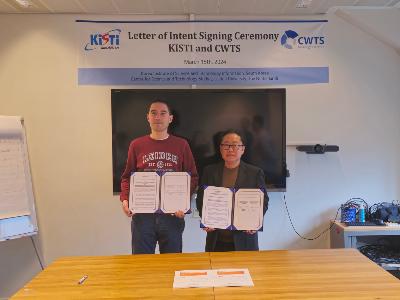
KISTI Signs Letter of Intent (LOI) with the Centre for Science and Technology St...
KISTI Signs Letter of Intent (LOI) with the Centre for Science and Technology Studies (CWTS) in the Netherlands - Establishing a sustained mutual research collaboration system for developing science and technology indicators using open data - The Korea Institute of Science and Technology Information (KISTI, President Kim Jae-soo) announced that it signed a Letter of Intent (LOI) with the Centre for Science and Technology Studies (CWTS) at Leiden University, Netherlands, on January 15 (local time). Both institutions agreed to cooperate on developing transparent and reproducible science and technology indicators utilizing open academic data. The CWTS is a globally recognized research institute specializing in the analysis of scholarly data. It is renowned for its expertise in foundational technologies such as the Leiden Clustering Algorithm and VOSviewer, a software for visualizing scholarly information. CWTS also manages the CWTS Leiden Ranking, which evaluates global universities based on scholarly output and impact. In 2021, KISTI established its Center for Global R&D Data Analysis to address increasing uncertainties in the global science and technology environment and the intensifying competition for technological supremacy. Since 2022, KISTI has collaborated with CWTS on international joint research projects. The two organizations have built mutual trust through collaborations such as constructing a science and technology scoreboard for Korean universities and research institutions and analyzing the mobility of researchers in Korea. These efforts form the foundation for pursuing long-term research cooperation. Under the LOI, the two institutions agreed to ▲ develop reproducible and diverse science and technology indicators using open data, while ensuring transparency in the analysis results and processes, ▲ enhance the visibility of local knowledge from various countries in global scholarly communication, and ▲ jointly collect information necessary for improving quantitative evaluation systems and establish a collaborative framework for reforming research evaluation systems. Additionally, as part of this agreement, KISTI will participate in the UNESCO Chair Programmes hosted by CWTS under the theme of “Diversity and Inclusivity in Global Science.” Through this program, both institutions will monitor diversity and inclusivity in science and collaborate on developing pluralistic perspectives in global scholarly communication. KISTI President Kim Jae-soo remarked, “Through this long-term partnership with CWTS, we aim to establish world-class analytical methodologies to support data-driven R&D decision-making. We also hope that this will serve as a stepping stone for international cooperation, enabling the development and utilization of diverse science and technology indicators to improve quantitative evaluation systems in the global scientific community.” -
072024. 02
No. 205 View. 98099
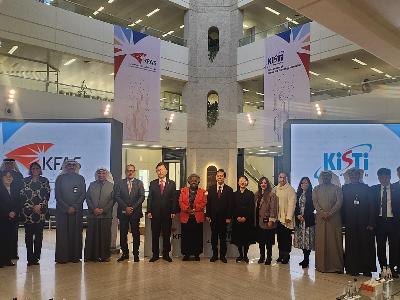
KISTI Establishes Strategic Partnerships with Kuwaiti Institutions in AI and Dat...
KISTI Establishes Strategic Partnerships with Kuwaiti Institutions in AI and Data Science- Laying a foundation for strategic cooperation in the Middle East based on MOUs with KFAS and KCST - The Korea Institute of Science and Technology Information (KISTI, President Kim Jae-soo) announced that it signed Memorandums of Understanding (MOUs) with the Kuwait Foundation for the Advancement of Sciences (KFAS) and the Kuwait College of Science and Technology (KCST) on January 5 (local time) in Kuwait. Established in 1976, KFAS is a nonprofit organization directly overseen by the Emir of Kuwait, dedicated to advancing national scientific and technological innovation. KFAS has been fostering science education and talent development initiatives. Its relationship with KISTI began in 2022 with a data education program for Kuwaiti high school students. The partnership is now set to expand, with expectations of driving digital innovation in data utilization for solving challenges in fields such as energy and the environment, as well as enhancing the big data capabilities of Kuwaiti talent. The MOU signing ceremony with KFAS, held in the presence of Korean Ambassador to Kuwait, includes key initiatives such as ▲ collaborative research and development projects between KISTI and Kuwaiti research institutions, ▲ development and operation of short- and long-term training programs to enhance digital capacities in data, supercomputing, artificial intelligence, and digital transformation, ▲ education and training programs in data science to foster future talent and develop STEM-related educational content. KCST, the second MOU partner, is a private university established in 2008 by an Emir decree. The university offers undergraduate programs in advanced technology fields such as electronics and communications engineering and computer science and aims to establish itself as a leading science and technology institution in the Middle East. Under the agreement, KISTI and KCST will ▲ develop collaborative research projects in national science and technology policies and R&D performance evaluation, ▲ exchange experts for collaborative ICT projects and research, and ▲ facilitate scientific information sharing and collaboration through symposia, conferences, and seminars. KFAS Director General Dr. Ameenah Rajab Farhan emphasized the significance of the partnership, stating, “Through this agreement, we aim to explore R&D collaborations in artificial intelligence and data science, extending beyond digital capacity building to contribute to the dissemination of scientific and technological knowledge.” KCST President Dr. Khalid Al-Begain highlighted, “We look forward to developing joint R&D initiatives and fostering the exchange of expertise and infrastructure between the two institutions.” Korean Ambassador to Kuwait, Chung Byung-Ha, remarked, “Since establishing diplomatic ties in 1979, South Korea and Kuwait have closely collaborated in energy and infrastructure. This partnership between KISTI and key Kuwaiti institutions opens doors for broader cooperation across various fields. The Embassy will continue to provide strong support for sustainable collaborations in science, technology, and education.” KISTI President Kim Jae-soo added, “This agreement with two prominent Kuwaiti institutions will strengthen cooperation in scientific R&D and education. We plan to leverage KISTI’s expertise in supercomputing, scientific data, and AI platforms to enhance exchanges with Middle Eastern research organizations.” During its visit to Kuwait, KISTI also engaged with other leading institutions, including the National Bank of Kuwait (NBK), Dasman Diabetes Institute (DDI), Kuwait Institute for Scientific Research (KISR), Zain Telecommunications Company (Zain), Gulf University for Science and Technology (GUST), and Kuwait University (KU). KISTI plans to pursue joint research with DDI on diabetes and other bioinformatics fields, while expanding collaborations in data science, artificial intelligence, and other areas. -
032023. 03
No. 204 View. 236374
Signals of the Future Detected by Artificial Intelligence
Signals of the Future Detected by Artificial Intelligence - KISTI publishes “Emerging Weak Signals 2023 in Science and Technology” - Following the release of its Weak Signals in Future Technology report and Forecast Report on Weak Signals in Future Technology in Korean last year, the Korea Institute of Science and Technology Information (President Kim Jaesoo, hereinafter KISTI) has published Emerging Weak Signals 2023 in Science and Technology, and English report on weak signals in science and technology with future potential detected using artificial intelligence. KISTI developed and released the findings on automated weak signal detection technology which uses data and algorithms to detect early signs of technology with potential for future growth last year. Weak signals- signals containing information about the future even though their significance remains yet to be seen in the present, are one way to explore technologies with potential for future growth. With technological hegemony and economic recession intensifying globally, it is imperative to swiftly and accurately detect early signs of future technologies to actively establish a nation’s strategy for the future that hastens technological innovation and ensures autonomy in future technologies. In response to such demands of the times, KISTI has released the Emerging Weak Signals 2023 in Science and Technology report presenting 439 weak signals in 24 fields of science and technology, which were detected using its independenly developed automated weak signal detection technology. This is a quantitative increase from the 391 weak signals detected in the previous year. Also presented in the same report are findings on weak signal dynamics, comparing and analyzing changes and trends between weak signals in this report and those detected previously. The specific data presented are newborn weak signals appearing for the first time, weak signals that remained unchanged in the span of a year, and weak signals that were largely the same but partially changed in content from the previous year. Weak signal dynamics research will empower a more accurate understanding of the specific qualities of technologies with future potential, facilitating the establishment of a strategy on future technologies. The automated weak signal detection technology developed by KISTI monitors global innovation trends such as the accelerating digital transformation and changing technological and industrial ecosystems in real time, presenting information swiftly and accurately to enable continous horizon scanning※ for understanding the future. It is hoped that the technology will provide digital insights to a wide range of entities performing research on technology innovation. ※ Horizon scanning - A systematic methodology for detecting early signs and trends in new technologies and social issues that could potentially become threats or opportunities with great influence in the future - Conventionally utilizes expert discussions and qualitative analysis, but attempts to use big data and AI analysis have been growing recently - Horizon scanning is a necessary step in predicting the future and shaping policy, widely utilized in the EU, UK, U.S. and the OECD -
292022. 07
No. 203 View. 273532

IDW 2022 & Open Science Workshop completed successfully
IDW 2022 & Open Science Workshop completed successfully - Strengthening international cooperation of open data-based R&D - KISTI hosted the world's largest data conference, International Data Week 2022 and co-events, under the theme of 'Data which is for better world making' on Seoul Dragon City Hotel from June 20th to 24th. IDW 2022 was a joint holding event to open & share research data with international organizations of data such as, Committee on Data(CODATA) which is an affiliated organization of International Science Council(ISC), World Data System(WDS), Research Data Alliance(RDA) which is the world's biggest research data initiative. And also KISTI, Korea Institute of Geoscience and Mineral Resources(KIGAM), Korea Institute of Oriental Medicine(KIOM), Korea Research Institute of Standards and Science(KRISS), National Library of Korea, and SungKyunKwan University(SKKU) hosted jointly. Furthermore for a successful hosting, Korean Ministry of Science and ICT, Korean Ministry of Culture, Sports, and Tourism, Seoul Metropolitan Government, National Research Council of Science & Technology of Korea, Korean National Commission for UNESCO and Korea Tourism Organization sponsored. For this event, a large number of experts and notables from data-related international organizations, Seoul Metropolitan Government, National Assembly of the Republic of Korea, research institutes, libraries, universities, and companies participated. This proves the advent of the era of data economy that affects not only S&T fields but also all fields, with an importance of data. 827 people(216 Koreans and 611 foreigners) who are data sharing-utilization researchers, enterprisers, policy experts, data scientists and data managers from 50 countries of all over the world(13 Asian countries, 20 European countries, 5 African countries, 2 North American countries, 4 South American countries, 2 Oceania countries, 4 Middle Eastern countries) attended the event online & offline. IDW 2022 was consisted of 139 sessions for 5 days: ▲8 plenary sessions under the theme of 'Data which is for better world making', ▲19th RDA plenary meeting's 73 sessions under the theme of 'Global infrastructure development and support to promote data sharing and re-use', ▲47 sessions of SciDataCon 2022 about the issues related research data, ▲KISTI Open Science Workshop and such 7 co-hosted events and 4 poster sessions. And there were various and meaningful discussions to share understanding the importance of Open data & its sharing in the Open Science era, by presentations of data policies and cases. Also KISTI had a meeting to enhance global cooperations with CODATA and ORCID in this week. Barend Mons, president of CODATA said, "We would like to ask for the role and support of KISTI as a representative organization of CODATA Korea.". Ivo Wijnbergen, manager of ORCID said, "We hope to find collaboration in promoting Open Data by linking KISTI's DataON and ORCID ID.". In the plenary session under the theme of 'Global State of Open Science', Choi Kwang-nam, director general of KISTI National S&T Data Division introduced all over the world's data experts a status of Open Science in Korea and KISTI, and a policy trend of Open Science in Korea. Furthermore he showed KISTI's platforms: AccessON, DataON, ScienceON, that can show a competitiveness of KISTI. On the 24th(Fri.), the last day of IDW 2022, KISTI held a one of co-event 'Open Science Workshop'. It aimed forming the understanding and consensus among Open Science stakeholders, and spreading the base of Open Science. The workshop became a place to share a status of national open science and cases to innovate S&T for the future. Industries-academia-research institutes participated online and offline, and its programs were ▲Open Science system·policy status and issues, ▲Direction of big data development through Open Access and Open Data, and ▲Open cooperation for an achievement of Open Science. In the 3 sessions, there were presentations and discussions of the current status and cases. Kim Jae-soo, president of KISTI said, "In IDW 2022 and Open Science Workshop, KISTI got a leading international position of data-driven R&D field by confirmation a capability of developing and supporting global infrastructure to promote data sharing and re-use. And with OECD and UNESCO, we could also lead Open Science by enhancing open data-based global R&D cooperation.". -
112022. 07
No. 202 View. 275969
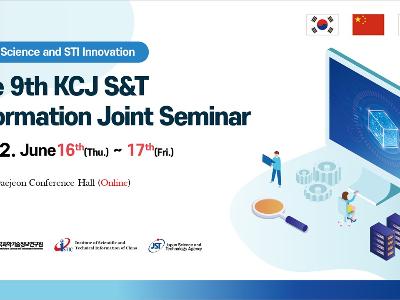
KISTI hosted the 9th Korea-China-Japan S&T information joint seminar
KISTI hosted the 9th Korea-China-Japan S&T information joint seminar - For 2 days online seminar from June 16th to 17th - - Representative information research institutes'(KISTI, ISTIC, JST) experts attended from those 3 nations - KISTI held 'The 9th Korea-China-Japan S&T Information Joint Seminar' from June 16th to 17th with those 3 nations representative information research institutes under the theme of 'Open Science and STI Innovation'. The Korea-China-Japan STI joint seminar took place from 2010, and has been co-hosted by KISTI, Institute of Scientific and Technical Information of China(ISTIC) and Japan Science and Technology Agency(JST). The purpose of this seminar is to share technologies and case reports for managing data efficiently which is the core value of S&T competitiveness and building a data open&share ecosystem, among those 3 institutes' researchers. Kim Jae-soo, president of KISTI appreciated to KISTI's 60th anniversary congratulations from ISTIC and JST, and hopefully said, "We will play a leading role in the field of STI through the cooperations with overseas research institutes.". Zhao Zhiyun, president of ISTIC and Koda Akira, vice president of JST sent greeting messages to state that they will co-work each other for promoting those 3 nations' friendship and establishing a cooperation system among the nations through an international interaction in data field. Nam Eun-kyung, senior engineer from Open Access Center of KISTI presentated about AccessON which is operated by KISTI as a national open access platform. In this seminar, researchers from the 3 institutes' shared knowledge and information about 4 themes of ▲ Open Science ▲ S&T Information Service ▲ STI Analysis Platform ▲ STI Cooperation and Innovation. KISTI focused on the latest content of DX innovation and STI cooperation, JST importantly introduced researches related to Open Science, and ISTIC showed high interest in the latest technologies and knowledge organizations about information service. Lee Hye-jin, director of Digital Curation Center of KISTI said, "Our plan is to establish an intelligent STI curation system and strengthen international cooperations for the digital transformation of the S&T information construction-sharing system through leading data standardization and intelligent technology development. This seminar will be a new starting point for global R&D cooperation and the DX.". -
072022. 07
No. 201 View. 278110
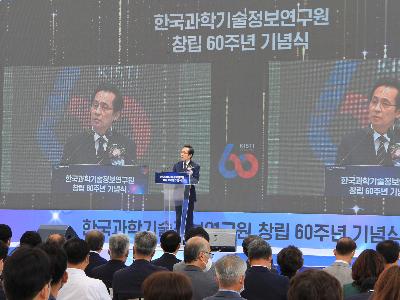
KISTI held a 60th anniversary ceremony of its foundation
KISTI held a 60th anniversary ceremony of its foundation - Chief Data Officer/Organization(CDO) which leads DX with national S&T data - KISTI held a ceremony of the 60th anniversary of its foundation at KISTI Daejeon HQ on June 9th. KISTI, which began as Korea Science & Technology Information Center(KORSTIC) in 1962, was launched in 2001 by integrating Korea Institute of Industry and Technology Information(KINITI) and Korea Research & Development Information Center(KORDIC). At the day, Oh Tae-Seog, the 1st vice minister of Korean Ministry of Science and ICT, Lee Sang-Min, the national assembly member of Korea, and Kim Bok-chul, the chairperson of National Research Council of Science & Technology of Korea, attended the ceremony. Starting with the DDS(Document Delivery Service) in 1962, KISTI has laid the foundation for the establishment of a national S&T data platform, including the Korea's first online information retrieval service in 1978 and the implementation of Hangeul(Korean language) searching service in 1985. In addition, regional information centers were built near the seats of city halls and provincial governments to promote a business supporting. In 1988, KISTI introduced the National Supercomputer No. 1(Cray), and also in the same year, the KREONET, a national S&T research network, was established to set a infrastructure for the R&D cooperation beyond the constraint of space. From 2001, KISTI was selected as an institute dedicated to establish a management and distribution system for S&T information, and in 2005, KISTI opened a network-based information protect service and expanded its cyber security infrastructure through the forming of Science and Technology Cyber Security Center to secure the security of goverment-funded institutes. In addition, it was appointed as a general managing institute of National Science & Technology Information Service(NTIS) in the same year. Through this, KISTI could integrate, manage and serve the national R&D data from all ministries. NTIS was awarded UN Public Service Award in 2012, and it also was exported its technology to Costa Rica to build their own R&D management system. In 2009, Association of Science and Technology Information(ASTI) was launched to construct an industry-academia-institute knowledge ecosystem for supporting regional SMEs which is suffering to commercialize R&D technologies. As of december 2021, ASTI had 15 regional organizations under a nationwide one and about 13,000 members. And they held a national conference and knowledge forums every year. In the DX era, KISTI also has been promoting a DX-ASTI strategy for supporting all ASTI members' digital transformation. Also in 2018, KISTI introduced the 5th national supercomputer, NURION to provide world-class supercomputing infrastructure for Korean researchers. On the other hand, for strengthening S&T data platform system, S&T knowledge infrastructure service(ScienceON), national research data platform(DataON), national open access platform(AccessON) was built. Through this, KISTI has been solidifying its position as the CDO. In the era of DX, KISTI is linking and cooperating S&T data, supercomputing, and intelligent information analysis infrastructure through the STI ecosystem which is established over 60 years. With constructing a S&T data dam, KISTI set a foundation for the AI linking and convergence of S&T knowledge resources. Also KISTI is leading the change of R&D trends in S&T DX for transition to digital economy through the establishment of quantum cryptographic network infrastructure and the cloud transformation of S&T information service. In addition, KISTI use the data to solve national pending issues like early flood warning, fine dust reduction, public transportation optimization and earthquake damage prediction. Moreover KISTI is driving the development of future agricultural data farms, global supply chain monitoring, and audio data utilization technology. At this day, Oh Tae-Seog, the 1st vice minister of Korean Ministry of Science and ICT praised efforts and achievements during 60 years and said, "KISTI, which has accumulated capabilities in S&T data and digital platform field, has to play a key role in leading S&T innovation and the digital transformation." Kim Jae-soo, president of KISTI said, "From the foundation of 1962, the ultimate goal of KISTI is to make Korea a world power through S&T innovation. As a national research institute of S&T data, KISTI will contribute to strengthen the S&T hegemonic competitiveness of Korea through opening the open science era, developing global super-gap computing technology, establishing intelligent data convergence analysis system and supporting S&T DX. We will do our best to promote the happiness of people and serve as a key institute of national S&T research beyond future 100 years."