
 Delete Article!
-
182026. 06
No. 240 View. 2398

KISTI Launches HPC Infrastructure to Enhance ASEAN Digital Capabilities
KISTI Launches HPC Infrastructure to Enhance ASEAN Digital Capabilities □ The Korea Institute of Science and Technology Information (President Sik Lee, hereafter KISTI) announced that it held an opening ceremony on June 18 at the National Research and Innovation Agency (BRIN) in Jakarta, Indonesia, to celebrate the official launch of High-Performance Computing (HPC) infrastructure designed to support data and artificial intelligence (AI) utilization across ASEAN nations. □ This international cooperation initiative is a core component of the Korea–ASEAN Digital Innovation Flagship Project (KADIF)*. Supported by the Ministry of Foreign Affairs of the Republic of Korea and the ASEAN–Korea Cooperation Fund (AKCF), the four-year project runs from September 2024 to 2028 with a total budget of $10 million. The project aims to enhance digital capabilities by providing ASEAN member states with a robust, HPC-based environment for research and application. * Korea–ASEAN Digital Innovation Flagship Project (KADIF): A project driven by the Ministry of Science and ICT (MSIT) to strengthen AI and digital capabilities within the ASEAN region □ The primary pillars of the project encompass ▲Establishing HPC infrastructure ▲Launching a National Science and Technology Information Service (NTIS) platform ▲Operating professional training and educational programs for HPC and AI utilization to train 160 specialists over the four-year period □ Currently, a majority of ASEAN nations, with the exception of Thailand and Singapore, face a shortage of domestic HPC infrastructure. In particular, they lack sufficient GPU-accelerated computing and Neural Processing Unit (NPU)-based HPC environments, which serve as the backbone for advanced data and AI utilization. □ To address these challenges, KISTI will establish a 4.2-petaflop (PF*) system to expand the regional research backbone network and bolster digital technology competitiveness. Furthermore, KISTI plans to support digital transformation across ASEAN nations by sharing its extensive HPC operational expertise and AI technical capabilities. * Petaflops (PF): A unit of computing performance equal to one quadrillion floating-point operations per second. □ In tandem with regional development, the project is expected to enhance the competitiveness of South Korea’s domestic digital industry by expanding the global market presence of homegrown AI semiconductors and security-related software. □ Satvinder Singh, Deputy Secretary-General of ASEAN, who attended the event on behalf of the Secretary-General of ASEAN, stated, "We expect this HPC infrastructure project to significantly contribute to elevating the digital, scientific, and technological competitiveness of ASEAN nations. ASEAN will actively support the establishment of a sustainable digital cooperation framework between Korea and ASEAN." □ Chul Lee, Ambassador of the Republic of Korea to ASEAN, stated, "I sincerely congratulate the launch of the HPC infrastructure, which will strengthen the digital R&D capabilities of ASEAN nations. I look forward to this project paving the way for new digital innovation partnerships and expanding R&D-based digital cooperation between Korea and ASEAN." □ KISTI President Sik Lee stated, "I hope that this HPC infrastructure launch for data utilization will substantially contribute to enhancing the digital capabilities of ASEAN nations and, furthermore, serve as a milestone to strengthen the foundation of science and technology cooperation between Korea and ASEAN." Korea-ASEAN HPC Infrastructure Opening Ceremony -
122026. 06
No. 239 View. 2756

KISTI Develops Innovative Technology to Evaluate AI Reasoning Processes
KISTI Develops Innovative Technology to Evaluate AI Reasoning Processes - Accepted at ICML 2026, a top-tier international conference on artificial intelligence and machine learning - Quantitatively assesses AI cognitive processes by analyzing reasoning structures rather than merely checking for correct answers □ The Korea Institute of Science and Technology Information (President Sik Lee, hereafter KISTI) announced on June 12 that a research team led by Dr. Heyoung Yang at the Applied Agent Research Center has developed TRACE (Toulmin-based Reasoning Assessment through Constructive Elements), a novel evaluation technology capable of assessing the reasoning processes of artificial intelligence (AI). This research achievement has been accepted for presentation at the International Conference on Machine Learning (ICML) 2026, one of the world's most prestigious conferences in the fields of AI and machine learning. □ ICML is recognized as a globally leading conference representing the fields of artificial intelligence and machine learning. It serves as a premier academic event where the latest AI research breakthroughs from global research institutions and major big tech companies are presented annually. □ Recently, Large Language Models (LLMs) have demonstrated high performance using Chain-of-Thought (CoT) prompting to solve complex problems step-by-step. However, conventional evaluation methods focus heavily on the correctness of the final output. This makes it difficult to understand the path the AI took to arrive at its conclusion and limits evaluation capabilities in environments where ground-truth answers are unavailable. □ To overcome these limitations, the research team developed an evaluation technology that simultaneously analyzes an AI’s reasoning structure and self-monitoring process. This was achieved by combining the Toulmin argumentation model—a representative framework in argumentation theory—with the metacognition theory of cognitive psychologist John Flavell. □ TRACE deconstructs reasoning sentences generated by AI into eight distinct elements: Claim, Evidence, Warrant, Backing, Evaluation, Qualifier, Rebuttal, and Monitoring. It then analyzes the validity of each element as well as the logical connectivity between sentences. □ The research team trained the TRACE-DeBERTa model using approximately 100,000 reasoning sentences and analyzed over 26,000 reasoning instances across seven major language models. The results demonstrated a high correlation (Pearson $r=0.741$) between TRACE scores and actual benchmark accuracy. □ TRACE demonstrated potential not only as an evaluation metric but also as an effective reward signal for LLM reinforcement learning. When TRACE was integrated into conventional Reinforcement Learning with Verifiable Rewards (RLVR) methods—which previously relied solely on the correctness of answers as a reward signal—the team confirmed that the reasoning performance of LLMs could be enhanced even further. □ Dr. Heyoung Yang of KISTI stated "TRACE can explain at which stage the AI reasoned logically and at which stage uncertainty or self-contradiction occurred. This can complement the limitations of existing black-box evaluation methods and those that depend entirely on ground-truth answers." □ Recent AI research is moving beyond mere performance competition toward evaluating and understanding the specific evidence and logic AI uses to reach conclusions. The acceptance at ICML 2026 signifies that TRACE has been recognized for its academic and practical value in the field of AI reasoning evaluation. □ Paper Overview ○ Title: TRACE: Toulmin-based Reasoning Assessment through Constructive Elements for LLM CoT Evaluation (https://doi.org/10.48550/arXiv.2605.29656) ○ Conference: The 43rd International Conference on Machine Learning (ICML 2026) ○ Authors: Yundong Kim (First Author), Heyoung Yang (Corresponding Author) TRACE (Toulmin-based Reasoning Assessment through Constructive Elements) -
122026. 06
No. 238 View. 2366

Effective International Research Collaboration: Being a Strong Partner Matters M...
Effective International Research Collaboration: Being a Strong Partner Matters More Than Finding One - International joint research does not guarantee synergy through collaboration alone - Customized cooperation strategies required based on national capability gaps and defined roles □ The Korea Institute of Science and Technology Information (President Sik Lee, hereafter KISTI) announced the publication of a report titled "Conditions for Synergy Effects in Data-Driven International Research Collaboration" (Data Insight, Vol. 58). This report provides an in-depth analysis of the outcomes of international research collaborations. International research collaboration has long been utilized as a key mechanism for strengthening research capabilities and expanding global networks. ○ This report challenges the conventional assumption that international joint research is inherently effective when conducted at the state level. ○ While the outcomes of international joint research can manifest as synergy compared to the capabilities of the participating nations, the report also analyzes the potential for these collaborations to result in "knowledge outflow" or the "Ringelmann effect." ○ To this end, the report examines the conditions under which synergy effects emerge in international joint research and the factors that maximize their magnitude, focus ing on three core hypotheses. ※ The Ringelmann Effect: A phenomenon where the performance of a group does not increase in proportion to the sum of individual capabilities as more members join (the opposite of synergy). Originating from the rope-pulling experiments of German psychologist Max Ringelmann, it describes collaborative outcomes that fall short of the sum of individual potentials (Ingham et al., 1974). □ The first hypothesis states that, "If joint research with a partner country was effective, the outcome should exceed the combined capabilities of both nations." ○ According to previous studies, international joint research outcomes receive relatively higher visibility (Katz & Martin, 1997) and exert greater influence than purely domestic papers (Collet et al., 2014; Lariviere et al., 2015; Sugimoto et al., 2017; Wagner et al., 2019; Dusdal et al., 2021). ○ However, the report's analysis reveals that it is difficult to expect synergy effects from international joint research through the mere act of collaboration alone. [Figure 1] Annual shifts in the proportion of the three baseline effects in U.S.–China joint research outcomes ○ An analysis of U.S.–China joint research based on sub-categories showed that the proportion of outcomes demonstrating synergy expanded from 61.3% in 2008 to 91.3% in 2018. This expansion is analyzed to be driven by a narrowing capability gap between the two nations. ○ However, in 2023, the proportion of synergy effects decreased to 85.8%. This limitation demonstrates that the manifestation of synergy cannot be explained solely by a reduction in national capability gaps. □ To explain instances where the first hypothesis does not hold, the second hypothesis posits that "When a knowledge outflow phase occurs instead of a synergy effect, the capability gap between the “Teacher” country and the “Student” country is substantial." Based on this, the report analyzes the impact of capability gaps on the manifestation of synergy. [Table 1] Tendencies based on the capability gap between Teacher and Student countries ○ Notably, whether synergy effects manifest depends not only on the size of the capability gap but also on which nation assumes the role of the "Teacher" country. ○ This implies that even at identical capability levels, the realization of synergy can vary depending on the specific country. □ The third hypothesis moves beyond the mere presence of synergy to analyze the factors influencing the level of excellence (magnitude) in joint research outcomes. In this process, the perspectives of the "Teacher" country and the "Student" country were analyzed separately. [Table 2] Conditions for excellent joint research outcomes based on country perspective ○ Generally, excellent outcomes in joint research are expected to occur when both the Teacher and Student countries possess high research capabilities. ○ However, when analyzed by separating each country's positioning, the tendencies of Teacher and Student countries proved to be contradictory. □ Dr. Seung-Pyo Jun, Principal Researcher at the KISTI Global R&D Data Analysis Center, stated, "By utilizing the Web of Science database refined and constructed by the KISTI Global R&D Data Analysis Center, we analyzed the academic outcomes of international cooperation between the United States and China. The results confirm that synergy in international joint research is not automatically derived." ○ He further noted, "Collaboration between countries with small capability gaps showed a high probability of generating synergy and tended to be achieved relatively easily. In contrast, high-quality joint research outcomes that go beyond simple synergy were achieved only when the research capabilities of both nations were exceptionally high. ○ Therefore, before engaging in international cooperation to elevate research standards, it is vital to secure sufficient domestic capabilities first. Based on this, synergy can be expected when cooperating with countries of a similar capability." ○ Dr. Jun added, "For South Korea to simultaneously achieve synergy effects and elevate its research capabilities through international cooperation, we need differentiated strategies depending on whether we act as the 'Teacher' or 'Student' country in relation to our partner. Simply choosing a country with a narrow capability gap or with high absolute capabilities is not enough." ☞ Learn more about this report (KR): https://www.kisti.re.kr/post/data-insight/6882?t=1778113685145 -
162026. 04
No. 237 View. 8175
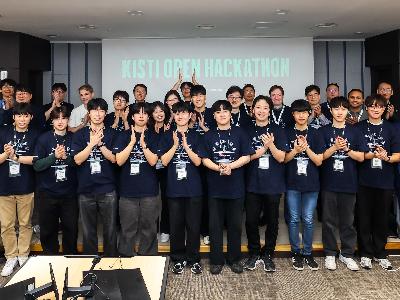
KISTI Concludes the 2026 KISTI Open Hackathon
KISTI Concludes the 2026 KISTI Open Hackathon - Co-hosted with HPE, NVIDIA, and the OpenACC Organization - Research Conducted Using the Pilot System of KISTI’s 6th National Supercomputer, “HANGANG” - With the Introduction of “HANGANG,” the Event Enabled Pilot-System-Based Research and Expanded Researcher Exchange □ The Korea Institute of Science and Technology Information (KISTI, President Sik Lee) successfully held the 2026 KISTI Open Hackathon, jointly organized with Hewlett Packard Enterprise (HPE), NVIDIA, and the OpenACC Organization. The event began with an online orientation and team–mentor meetings on 25 March, followed by the main hackathon held from 31 March to 3 April at KIUM Hall of KISTI. * A hackathon is a compound term combining “hacking” and “marathon,” referring to a team-based event in which participants work intensively over a set period to develop prototype-level outcomes. □ Now in its third year, the hackathon drew applications from 25 teams. Of these, eight teams comprising 29 participants were selected, including four teams in high-performance computing (HPC) and four teams in artificial intelligence (AI). The selected participants conducted research on code optimization and performance acceleration in the AI and HPC fields using the pilot system of KISTI’s 6th national supercomputer, “HANGANG” (hereafter “Supercomputer No. 6”), equipped with four GH200s per node across a total of 22 nodes. * The pilot system is a testbed environment built ahead of the deployment of the main supercomputing system so that researchers can verify performance and optimize their codes in a real research environment. □ The hackathon focused on research projects across a wide range of fields, including artificial intelligence, materials engineering, bioscience, molecular dynamics, and computational fluid dynamics. A total of 17 domestic and international experts from KISTI, NVIDIA, and HPE, participating in the KISTI–HPE–NVIDIA Center of Excellence (CoE), served as mentors throughout the event. Participants used parallel computing and machine-learning frameworks such as OpenACC, PyTorch, and CUDA to address research challenges through code optimization and performance improvement. * The Center of Excellence (CoE) is an AI·HPC expert collaboration framework jointly operated by KISTI, HPE, and NVIDIA to strengthen capabilities in GPU-accelerated computing and scientific AI research based on the sixth national supercomputer “HANGANG.” ○ Each participating team achieved performance acceleration of up to 41.8 times by using the GH200-based pilot system of Supercomputer No. 6, compared with the previous-generation A100 GPU architecture. Some teams also succeeded in expanding computational scale by more than twofold by leveraging the advantages of the new GPU architecture’s memory capacity and bandwidth. ○ Through close collaboration with mentors specializing in each field, participants applied code profiling, parallelization, and optimization techniques, enabling them to achieve results that significantly exceeded their original goals. □ In addition, participants and mentors shared their experiences in code optimization and performance improvement through daily scrum sessions held throughout the event. These sessions allowed each team to identify issues and areas for improvement in real time and make immediate adjustments. Based on the outcomes of the daily scrums, mentor meetings were held each evening to provide feedback tailored to each team, helping enhance engagement throughout the hackathon. Communication was also highly active through the online collaboration platform, where numerous posts were shared, further strengthening exchange and collaboration among participants. □ Jihoon Kang, Director of the Supercomputing Application Research Center at KISTI, stated “this hackathon was especially meaningful in that it enabled researchers to proactively apply GPU-based parallel computing technologies and strengthen their practical capabilities by using the pre-established pilot system ahead of the launch of the next-generation supercomputer ‘HANGANG.’ In particular, we plan to further expand CoE collaboration and continue supporting both the creation of research outcomes and broader collaboration among researchers through hackathons.” Welcome Remarks by KISTI President Sik Lee at KISTI Open Hackathon KISTI Open Hackathon KISTI Open Hackathon KISTI Open Hackathon Group Photo at KISTI Open Hackathon -
132026. 04
No. 236 View. 8640
KISTI Builds the World’s First Secure Global Research Backbone… Accelerating Int...
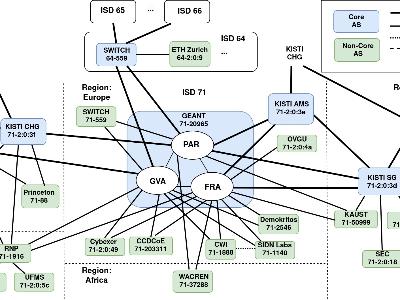
KISTI Builds the World’s First Secure Global Research Backbone… Accelerating International Joint Research Collaboration - KISTI and ETH Zurich Sign MOU to Build and Operate a Secure Global Research Backbone Network □ The Korea Institute of Science and Technology Information (KISTI, President Sik Lee) signed a memorandum of understanding (MOU) with ETH Zurich on April 9 to advance the establishment and operation of the world’s first secure global research backbone and to promote future international joint research. The initiative is based on SCION, a next-generation Internet architecture that addresses the limitations of the conventional Internet built on Internet Protocol (IP) and Border Gateway Protocol (BGP). * SCION (Scalability, Control, and Isolation On Next-Generation Networks) is a future Internet architecture developed by ETH Zurich’s Network Security Group, led by Professor Adrian Perrig. Designed to address security issues in the current Internet, SCION significantly enhances network security. It is already being used in Switzerland, including by the Swiss National Bank and more than seven ISPs. □ KISTI’s Korea Research Environment Open NETwork (KREONET) has been pursuing cooperation with ETH Zurich’s Network Security Group since 2017. Following in-depth discussions beginning in 2021 on SCIERA, a secure global research backbone based on SCION, KREONET of Korea, GÉANT of Europe, and SWITCH, the Swiss National Research and Education Network, have jointly built and are now operating the SCIERA backbone. * SCIERA (SCION Education, Research and Academic Infrastructure) is a SCION-based global research network that connects researchers across Asia, North America, South America, Europe, and even Africa. KISTI has established and is operating the SCIERA infrastructure over KREONET across the Asia–North America–Europe segment. □ KREONET is a world-class national research and education network capable of transmitting massive volumes of data at ultra-high speed for big science, convergence research, and the fields of artificial intelligence (AI), quantum, and high-performance computing (HPC). Through this MOU, the two institutions will pursue △ the joint development and operation of SCIERA, △ the establishment of a secure science and technology research backbone based on SCION, and △ the development of advanced testbeds. In addition, the two sides plan to expand SCION-based international joint research through international collaborative research programs, including the European Union’s Horizon programme. □ Buseung Cho, Director of KREONET Center at KISTI, said, “Through cooperation with the ETH Zurich SCION team, we will not only advance the establishment and operation of the SCIERA infrastructure as a secure global research backbone, but also prepare joint international research to develop SCION-based high-performance virtual private network (VPN) technologies between Korea and Switzerland, as well as between Korea and Europe. We will further strengthen practical research collaboration so that these technologies can be applied to global scientific and technological research fields that require highly secure and high-performance networks.” □ Professor Adrian Perrig of ETH Zurich, who leads the SCION project, said, “KISTI is a highly innovative research institute in networking, and KREONET is a globally leading research and education network. We are very excited to collaborate with KISTI to build the world's first high-security research network.” KISTI–ETH Zurich MOU Signing Ceremony Architecture of the SCION-based Global Research Network -
092026. 04
No. 235 View. 9632
KISTI Conducts its 3rd Training Program to Build HPC Infrastructure for ASEAN Da...
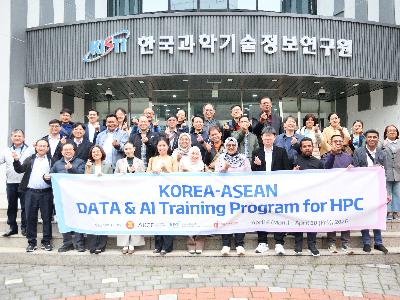
KISTI Conducts its 3rd Training Program to Build HPC Infrastructure for ASEAN Data Utilization □ The Korea Institute of Science and Technology Information (KISTI, President Sik Lee) will conduct the third five-day training program under its project “Building HPC Infrastructure and HPC Capacity for ASEAN Data Utilization” from 6 to 10 April. □ This training program has been designed to transfer KISTI’s high-performance computing (HPC) technologies and operational know-how to ASEAN countries and cultivate core talent in AI and data utilization. The project is part of the Korea-ASEAN Digital Innovation Flagship (KADIF) and is being implemented with support from the ASEAN-Korea Cooperation Fund (AKCF), with a total budget of USD 10 million (approx. KRW 14.7 billion) over four years from September 2024 to September 2028. □ Alongside the training program, KISTI plans to support digital transformation and advancement in science and technology across ASEAN countries by sharing and promoting the use of data-driven research environments, including HPC infrastructure, the Korea Research Environment Open NETwork (KREONET), and the National Science & Technology Information Service (NTIS). Through this project, KISTI also plans to train a total of 160 specialists in HPC and data utilization over four years and to strengthen science and technology capabilities across the region through the continued operation of the training program. □ The course modules include ▲the Fourth Industrial Revolution with an AI focus, ▲Linux training, ▲Machine-learning models using Teachable Machine, ▲Understanding and Utilizing Supercomputers, ▲Supercomputing Utilization, ▲Supercomputing Network, ▲Introduction to NTIS and its utilization, and ▲Supercomputing for AI. □ Through this training, KISTI plans to strengthen capabilities in operating computing environments and applying AI technologies for ASEAN countries where HPC infrastructure remains relatively limited, while supporting digital transformation in science and technology. □ President Sik Lee of KISTI stated “Participant satisfaction in the previous two training sessions was very high. Through the total of eight sessions planned over the project period, we will contribute to nurturing core HPC talent in the ASEAN region and continue building a foundation for stronger Korea-ASEAN science and technology cooperation.” Group Photo of Participants in the 3rd HPC Training Program for ASEAN Data Utilization at KISTI Group Photo of Participants in the 3rd HPC Training Program for ASEAN Data Utilization at KISTI -
192026. 03
No. 234 View. 12840
KISTI Partners with NVIDIA and IonQ to Build a Leading ‘Quantum–HPC Hybrid’ Infr...
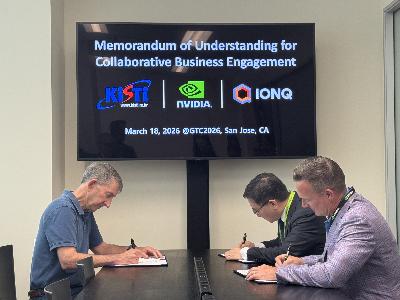
KISTI Partners with NVIDIA and IonQ to Build a Leading ‘Quantum–HPC Hybrid’ Infrastructure - Trilateral agreement signed at GTC… linking Supercomputer No. 6 “HANGANG” with the quantum computer “Tempo” - Collaboration on integrated quantum–HPC technologies, AI model optimization, and global talent development - Securing computing infrastructure as a key enabler of the “K-Moonshot” Project and “Science and Technology × AI national strategies” □ The Korea Institute of Science and Technology Information (KISTI, President Sik Lee) announced that it signed a trilateral memorandum of understanding with global AI computing company NVIDIA and quantum computing company IonQ in San Jose, United States, on March 18 (local time). The agreement aims to promote collaboration on quantum–high-performance computing hybrid computing technologies and to foster a related ecosystem. □ The agreement was pursued as part of the “Establishment of Quantum Computing Services and Utilization Framework” project supported by the Ministry of Science and ICT. The three organizations agreed to work together to build a world-class quantum–HPC hybrid computing environment by physically linking IonQ’s next-generation quantum computer “Tempo,” to be installed at KISTI, with Korea’s sixth national supercomputer “HANGANG,” scheduled to begin operation in the second half of this year. □ In particular, the collaboration aims to go beyond simple infrastructure integration by developing an integrated platform that enables complex algorithms for solving scientific grand challenges to be simulated on a supercomputer and then optimized for execution on real quantum hardware. Key areas of collaboration include the following. • Joint R&D on quantum–HPC hybrid technologies: integration of IonQ’s quantum hardware with KISTI’s HPC infrastructure and development of related application technologies • Next-generation algorithm simulation: joint research on simulation technologies and applications for next-generation quantum hardware and algorithms • Quantum-accelerated AI model development: research and optimization of AI models to accelerate advances in quantum technologies • Global quantum talent development: exchange of research personnel, joint workshops, and specialized training programs • Expansion of Korea’s quantum ecosystem: joint efforts to broaden the adoption of quantum computing in Korea and stimulate the domestic industry ecosystem □ This collaboration is expected to mark an important turning point for elevating Korea’s technological standing amid intensifying global competition in quantum computing. While quantum computing and supercomputing have historically developed as separate domains, global technology trends are rapidly shifting toward hybrid models that combine the strengths of both systems. Through this trilateral collaboration, Korea will establish a practical demonstration case linking a high-performance GPU-based supercomputer with a commercial ion-trap quantum computer. This initiative is expected to position Korea as a leading country in the development of global quantum hybrid computing technologies. □ NVIDIA and IonQ, the partner organizations in this initiative, will provide strong support for infrastructure development at KISTI based on their world-leading technologies. NVIDIA will provide the software stack centered on its quantum–HPC integration platform CUDA-Q, enabling high-speed simulation of quantum algorithms and real-time integration with physical quantum hardware. In particular, NVIDIA’s NVQLink enables the integration of quantum processors with its latest accelerated computing technologies, significantly improving the speed of quantum error correction (QEC). □ IonQ will provide its next-generation ion-trap quantum computer “Tempo” with 100 qubits. Tempo utilizes barium-ion technology to deliver high fidelity and long coherence times and is designed to achieve performance equivalent to 64 algorithmic qubits (#AQ*64), enabling computational capabilities approaching real-world industrial problem solving. * #AQ (Algorithmic Qubits): a metric used to measure the effective performance of a quantum computer, indicating how accurately real algorithms can be executed rather than simply the number of physical qubits. □ Jensen Huang, CEO of NVIDIA, stated during his visit to Korea in October last year that “in the near future, all NVIDIA GPU supercomputers will evolve into hybrid systems closely integrated with quantum processors.” At that time, he also pledged to establish a Center of Excellence (CoE) for technical collaboration with KISTI. IonQ has likewise strengthened cooperation to expand Korea’s quantum computing ecosystem, including signing an agreement with the Ministry of Science and ICT in January this year to establish a “Quantum Solution Innovation Hub.” These developments laid a solid foundation for the present trilateral collaboration. □ Through this collaboration, KISTI will combine its accumulated expertise in operating national HPC infrastructure with NVIDIA’s accelerated computing technologies and IonQ’s high-performance quantum hardware. Based on this synergy, researchers in Korea are expected to gain access to a practical research infrastructure capable of addressing complex challenges, such as drug discovery, advanced materials research, and financial optimization, within a world-class quantum–HPC hybrid computing environment. This initiative is also expected to serve as a key foundation for supporting the government’s “K-Moonshot” Project, which aims to accelerate scientific innovation and address national missions through the integration of “Science and Technology × AI.” □ KISTI President Sik Lee stated: “This trilateral collaboration will serve as a major turning point in leading global trends in quantum–HPC integration technologies while providing researchers in Korea with world-class computing environments. By maximizing the synergy between the sixth national supercomputer ‘HANGANG’ and the quantum computer ‘Tempo,’ we will make every effort to ensure that Korea emerges as a key hub in the global quantum economy.” (From left) Marc Hamilton, Vice President of Solutions Architecture and Engineering, NVIDIA; Sik Lee, President of KISTI; and Scott Millard, Chief Business Officer, IonQ (March 18, 2026, San Jose, United States) -
192026. 03
No. 233 View. 12089
KISTI Expands AI and HPC Collaboration with NVIDIA and HPE Based on Supercompute...
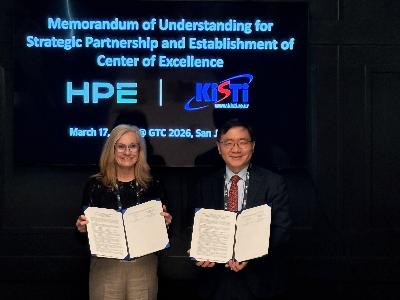
KISTI Expands AI and HPC Collaboration with NVIDIA and HPE Based on Supercomputer No. 6 “HANGANG” - Collaboration on scientific AI model development and GPU-accelerated computing using Supercomputer No. 6 - Operation of an AI·HPC Center of Excellence (CoE) to optimize GPU clusters and expand scientific computing research - Expected to strengthen essential computing resources for implementing the “K-Moonshot” Project and “Science and Technology × AI national strategy” □ The Korea Institute of Science and Technology Information (KISTI, President Sik Lee) announced that it has signed separate memoranda of understanding (MOUs) with NVIDIA and Hewlett Packard Enterprise at NVIDIA GTC 2026 held in San Jose, United States, to advance collaboration in high-performance computing (HPC) and artificial intelligence (AI). The agreements aim to expand next-generation computing research centered on Korea’s sixth national supercomputer, “HANGANG” (hereafter referred to as Supercomputer No. 6), which is scheduled to begin service in the second half of this year. Through this collaboration, the partners plan to strengthen scientific research capabilities using AI and HPC technologies. □ On March 17 (local time), KISTI first signed an MOU with HPE to establish a strategic technology collaboration framework for AI and HPC research using Supercomputer No. 6. The two organizations will maximize the utilization of the supercomputing infrastructure through a Center of Excellence (CoE) program and further advance an integrated research environment aimed at addressing complex scientific challenges. □ KISTI will leverage its accumulated expertise in supercomputing service operations to enhance the services of Supercomputer No. 6 and support the growth of Korea’s research community. HPE will provide technical consulting and optimization support based on its global technology capabilities and system architecture expertise. Through this partnership, the two sides plan to optimize the configuration of GPU clusters, advance large-scale scientific foundation model training environments, and pursue technical collaboration on building a quantum–HPC hybrid service environment. They will also optimize major scientific application software for GPU environments to improve computational performance and scalability, while expanding collaborative research in areas such as computational science simulations and AI-driven surrogate modeling. □ On March 18 (local time), KISTI signed a second MOU with NVIDIA to promote collaboration in AI and accelerated computing based on Supercomputer No. 6. The agreement operationalizes the Center of Excellence (CoE) collaboration plan between KISTI and NVIDIA that was announced at the APEC CEO Summit held during the APEC Economic Leaders’ Meeting in Gyeongju in October last year. The initiative aims to expand scientific AI research and GPU-accelerated computing collaboration centered on Supercomputer No. 6. □ The partners plan to jointly develop large-scale scientific AI models and domain-specific foundation models using the GPU environment of Supercomputer No. 6. Priority research areas include biotechnology, materials and chemistry, earth sciences, and semiconductor research. In addition, Supercomputer No. 6 will support quantum computing research through a quantum–HPC hybrid computing environment that integrates the system with the quantum computer Tempo. □ The collaboration will also focus on optimizing existing major supercomputing application software for GPU environments to verify performance improvements and expand research cooperation in GPU-accelerated computational science. KISTI and NVIDIA will further operate educational programs, including GPU bootcamps, hackathons, and workshops, to help researchers effectively utilize supercomputing and AI infrastructures. □ Through these partnerships, KISTI aims to build a next-generation research infrastructure that integrates AI and HPC technologies centered on Supercomputer No. 6, while enabling domestic researchers to access world-class computing environments. This initiative is expected to serve as an important first step in strengthening AI computing resources to support the successful implementation of national strategies, including the “Science and Technology × AI” initiative, which seeks to double research productivity by 2030 by integrating scientific resources and research capabilities, and the “K-Moonshot” Project, which aims to address 12 national missions across eight strategic fields by 2035. □ KISTI President Sik Lee stated: “Supercomputer No. 6 is a key asset of Korea’s digital research infrastructure. Through collaboration with NVIDIA and HPE, we will build a next-generation research environment that integrates AI and HPC technologies and further strengthen the competitiveness of Korea’s strategic research fields.” (From right) Sik Lee, President of KISTI, and Trish Damkroger, Senior Vice President and General Manager of HPC & AI, Hewlett Packard Enterprise (March 17, 2026, San Jose, United States) (From right) Sik Lee, President of KISTI, and Marc Hamilton, Vice President of Global Solutions Architecture and Engineering, NVIDIA (March 18, 2026, San Jose, United States) -
272026. 02
No. 232 View. 12965
KISTI Launches the “AI SilkNet Center” as a Central Asia Hub for AI Collaboratio...
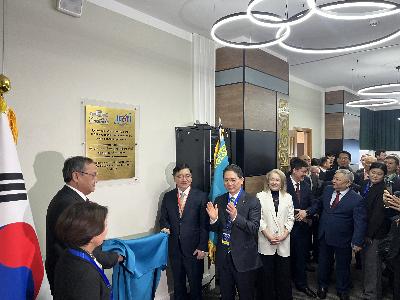
KISTI Launches the “AI SilkNet Center” as a Central Asia Hub for AI Collaboration - Joint Korea–Kazakhstan data-driven platform goes into full operation with the National Academy of Sciences of the Republic of Kazakhstan - Expected to expand data- and AI-enabled policymaking and industry collaboration across the region □ The Korea Institute of Science and Technology Information (KISTI, President Sik Lee) announced the launch of the AI SilkNet Center, a new hub for artificial intelligence (AI) cooperation in Central Asia, established jointly with the National Academy of Sciences of the Republic of Kazakhstan (NAS). The Center is significant as a shared platform that combines KISTI’s strengths in science and technology (S&T) information analysis with local research infrastructure in Kazakhstan. * NAS is Kazakhstan’s leading national scientific institution. It develops S&T strategies with the country’s top scholars, provides expert advice to government decision-making, advances basic research and its linkage to applications, and supports Kazakhstan’s scientific independence and intellectual sovereignty. □ On February 26 (local time), KISTI and NAS held an opening ceremony for the AI SilkNet Center in Almaty, Kazakhstan. The launch coincided with the 80th anniversary of NAS, adding symbolic significance to the event. The two organizations plan to expand cooperation beyond research exchange to broader collaboration spanning policy and industry. □ The AI SilkNet Center is designed as a digital cooperation platform that connects Central Asia’s S&T outlook with practical AI applications. The Center will pursue nine strategic goals: ▲education, ▲analysis and research, ▲community building, ▲technical support, ▲sustainable development, ▲digital solution development, ▲support for scientific research, ▲publication of academic journals, and ▲financial self-reliance. Through these efforts, the Center aims to strengthen research capacity while also supporting data-driven policymaking and technology commercialization, positioning itself as a regional hub for the AI ecosystem. □ KISTI’s accumulated capabilities, including S&T big data analytics, building patent- and publication-based knowledge networks, and experience leveraging high-performance computing (HPC), will serve as core assets for the Center’s operations. Kazakhstan, which is working to modernize its resource-based economic structure and transition toward advanced technology industries, has identified stronger capabilities in data- and AI-driven strategy development as a key priority. The AI SilkNet Center is expected to provide a practical platform that meets these needs. □ The opening ceremony was attended by Sik Lee, President of KISTI; Gulzat Kobenova, Vice Minister of Science and Higher Education of the Republic of Kazakhstan; Dmitriy Mun, Vice Minister of Digital Development, Innovation and Aerospace Industry; Akhylbek Kurishbayev, President of NAS; Yelena Shevchenko, Vice President of NAS; and Tae Wook Ha, Consul General of the Republic of Korea in Almaty. Participants emphasized that S&T cooperation is a strategic asset closely tied to national competitiveness, and shared the need to expand personnel exchange and joint research. □ In his welcoming remarks, NAS President Akhylbek Kurishbayev stated that the AI SilkNet Center marks the ing point for a new cooperative model in S&T governance. He highlighted a focus on forecasting and data-driven analysis, strategic concentration of resources, and a performance-oriented management framework to mobilize capabilities in areas directly linked to national and regional development. He also noted that the Center can serve as a joint platform to shape future technology priorities between Korea and Kazakhstan and enhance innovation capacity across Central Asia. □ Following the welcome address, presentations were delivered on: ▲the transition to evidence-based S&T governance, ▲IP-based predictive analytics, ▲Kazakhstan’s technology commercialization outcomes and priorities, ▲ approaches to accelerating regional joint research program development, and ▲opportunities to participate in the EU’s Horizon Europe program. □ The AI SilkNet Center plans to pursue multi-layered cooperation initiatives, including identifying joint R&D projects, operating professional training programs, expanding international academic networks, and supporting technology commercialization. The Center will also explore pathways to scale into a regional AI innovation platform by strengthening linkages with neighboring Central Asian countries. □ President Sik Lee said, “The AI SilkNet Center is a leading example of Korea and Kazakhstan building a knowledge-based cooperation framework powered by AI. KISTI will actively support this partnership so that it contributes to digital transformation and enhanced S&T competitiveness across Central Asia.” Plaque Unveiling Ceremony Opening Ceremony of the AI SilkNet Center Distinguished Guests at the AI SilkNet Center Opening Ceremony (From right: Sik Lee, President of KISTI, Akhylbek Kurishbayev, President of NAS, Yelena Shevchenko, Vice President of NAS) Welcome Address by Sik Lee, President of KISTI Sik Lee, President of KISTI, Interviewed by Kazakh Media -
022026. 02
No. 231 View. 149436
KISTI Hosts KISTI–BNPB Technology Exchange Meeting for Supercomputing Specialist...
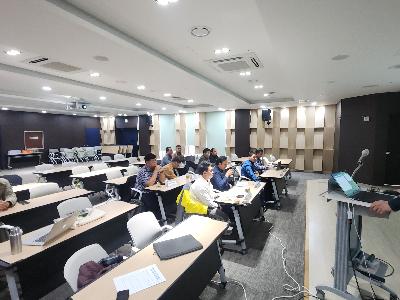
KISTI Hosts KISTI–BNPB Technology Exchange Meeting for Supercomputing Specialists In January 2026, the Korea Institute of Science and Technology Information (KISTI) hosted the KISTI–BNPB Technology Exchange Meeting for Supercomputing Specialists at its headquarters in Daejeon, welcoming supercomputing experts from Indonesia’s BNPB (Badan Nasional Penanggulangan Bencana). The meeting was organized as part of an ongoing KISTI-led initiative, the Establishment of Supercomputing Infrastructure and Utilization in Indonesia, which support BNPB in the transfer and utilization of supercomputing resources, with the aim of strengthening Indonesia’s capacity to independently operate and apply high-performance computing (HPC) systems for data-intensive analysis and disaster management. The initiative is led by Dr. Kwangjin Oh, Principal Researcher at KISTI. The meeting was attended by KISTI researchers and BNPB representatives, including Stefanus Santori Zen, First Informatics Manggala to the Assistant Deputy for the Management of Government Digital Transformation. The primary objective of the exchange was to facilitate technical dialogue between KISTI and BNPB supercomputing specialists. Participants shared experiences and perspectives on technical challenges, while engaging in structured training sessions focused on the operation, maintenance, and practical utilization of HPC systems, as well as HPC-based disaster response solutions tailored to Indonesia’s needs. The program took place over several days at KISTI’s Daejeon headquarters and combined technical briefings with hands-on training. Key activities included sessions on supercomputing system operation and maintenance, presentations on BNPB’s technical requirements, and discussions on building a cooperative framework to enhance practical understanding and effective use of supercomputing capabilities in both countries. Through this technology exchange, KISTI and BNPB advanced practical collaboration on the use of supercomputing for disaster response and capacity building. KISTI will continue to support international cooperation aimed at strengthening sustainable HPC operation and application in partner countries. Orientation session Visit to the supercomputing system room Tutorial session on HPC utilization Tour of the supercomputing facilities