
 Delete Article!
-
202012. 02
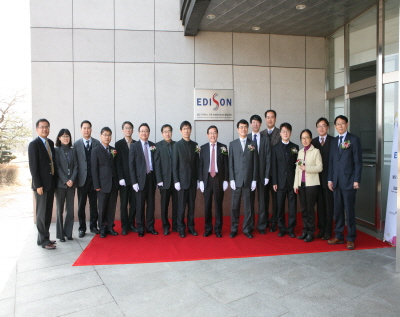
No. 70 View. 25040 KISTI held opening ceremony for EDISON CENTER at its head office in Feb.15th. EDISON is a short of Education-research Integration through Simulation On the Net and is designed to make students and graduate students of science and engineering area enable to utilize and simulate up-to-date research results on On-line. KISTI will provide them with EDISON platform connected with high-performance research network and research results in thermofluid and energy,chemistry,structural analysis and dynamics and Nano materials are available for use. Dr.Park young-seo,President of KISTI said that KISTI will support and strengthen its support for students and graduate students of science and engineering area by expanding and upgrading EDISON platform and its software.
-
162012. 02
No. 69 View. 26692
'Fundamental technology for hot electron solar cell' developed
KAIST Prof. Park Jung-yeong's team publishes study in September 14 issue of 'Nano Letters' a leading nano science journal The National Research Foundation of Korea (Chairman: Oh Se-jung) said, on October 6, that Korean scientists had developed a fundamental technology for hot electron solar cells that are created by absorbing solar light. The study was led by Prof. Park Jeong-young at the EEWS Graduate School in the Korea Advanced Institute of Science and Technology (KAIST, President: Suh Nam-pyo) and was assisted by master's program student Lee Young-keun and doctoral student Jung Chan-ho. Prof. Park's team detected hot electrons generated on the surface of nanodiode by light by using a nanodiode that consisted of a metal thin film and a metal oxide semiconductor, and transformed them into a nanosome measuring dozens of nanometers through surface treatment of the metal thin film of the nanodiode. This nanosome displayed a surface plasmon. The research team measured the hot electrons detected on nanodiode, and thus examined the amplification of hot electrons due to a surface plasmon. This suggested that a surface plasmon maximizes the generation of hot electrons, and this principle can be applied to increasing the efficiency of solar cells. Prof. Park said, "Accurately understanding and measuring hot electron is very important in surface science and energy engineering because it allows us to fundamentally understand the process of energy loss. The development of this fundamental technology related to hot electrons is expected to have applications in the development of high efficiency transformation devices." The study was published online first on September 14 in Nano Letters, a prestigious journal in the nano science field. #?Glossary o Hot electronHot electrons are generated on the surface due to energy conversion process when energy is transferred to the surface from outside. In this process, external energy entails various phenomena, including chemical reactions, such as the absorption of light, the absorption of molecules and catalytic reactions, or the colliding of electrons or ions. Converted energy allows for the flow of hot electrons on the surface. The detection of such hot electrons is possible by using a nanodiode comprised of a thin film oxide. Understanding and measuring these hot electrons holds significance in that it allows the process of energy loss at the molecular level to be better understood. o Surface PlasmonThis refers to quasi particles in which free electrons vibrate collectively on the surface of a metal. The phenomenon whereby light is contained on the surface of a metal, due to the interaction of light and free electrons within the metal, is called surface plasmon resonance. As a result of this surface plasmon resonance, the intensity of the metal?s electromagnetic field increases. The cross-section where light is absorbed by a metal changes due to a surface plasmon, and as a result, the penetration ratio of light changes at a certain wavelength at which the surface plasmon is visible. o Nanodiode A nanodiode is comprised of a metal thin film and semiconductor (oxide semiconductor or compound semiconductor), and it refers to the concept that hot electrons emerge on the surface of nanodiode before they are detected by overcoming Schottky energy barrier. Source - Hellodd.com -
162012. 02
No. 68 View. 26268 Using radioactive ray-mutation technology; 1st year cultivation under review The Korea Atomic Energy Research Institute (President: Jung Youn-ho) said, on September 27, that it had developed a new kenaf breed dubbed "Jangdae," which grows very well and whose seeds can be collected domestically, by using a radioactive ray-mutation breeding technique. Researchers led by Dr. Kang Shi-yong, in the radioactive ray-mutation breeding research team at the institute's Jeongeup Advanced Radiation Technology Institute, exposed kenaf collected from the Jinju region from 2003 to gamma rays and developed the new breed "Jangdae," which grows better than the original breed and whose seeds can be collected in Korean climate. Kenaf is an annual grass plant originating in West Africa and is one of the world's top three fiber plants. It is known as a botanical resource for various bio materials. Growing fast and consuming large volumes of carbon dioxide, the plant is also an eco-friendly industrial material for high-end paper, eco-friendly wall paper, construction boards, bio plastic, automobile frames and functional clothing.? Jangdae has been developed with research funds from the Life Industry Technology Development Program, under the Ministry of Food, Agriculture and Fisheries, and is being cultivated for demonstration at the pilot breeding farm at the Jeongeup Advanced Radiation Technology Institute. The application to register Jangdae for protection as a new breed has been completed, and first year cultivation review is underway at the pilot farming site at the Korea Seed and Variety Service. Tests have also been conducted to review the natural growing and anthesis trends under a mass cultivation environment in the Saemangeum reclaimed area in Gimje, North Jeolla Province. In Korea, research was conducted on pilot cultivation and the use kenaf in the production of sags that would replace rice thatch sags as containing grains in the 1960s, but the study was halted following the introduction of chemical sags in the early 1970s. Recently, amid growing interest in products sourced from kenaf, related research has been conducted sporadically, but researchers have had difficulties due to lack of a domestic breed. Imported kenaf grows relatively well in the weather conditions in Korea and yields a high bio mass. Because the foreign breed only blooms for anthesis in a tropical climate, however, it has been impossible to procure seeds, and thus it was difficult to re-cultivate the plant domestically.?? The domestic development of Jangdae has made it possible to gather seeds and re-cultivate the species in the climatic conditions in Korea, opening up the possibility for kenaf's wide use as an eco-friendly industrial and functional material. Also, domestic development of the breed also reduces the expenses associated with seed license royalties and helps increase income for farming households, while allowing Korea to generate income through its export to foreign countries. Once Jangdae is registered as a new breed, KAERI will seek the mass production and introduction of the new breed in Korea. Trial cultivation is underway at the pilot farming site in the Saemangeum Reclamation Area in Gimje in collaboration with the Jeollabuk-do Agricultural Research & Extension Service. A plan has been set up for the mass cultivation of the breed, in cooperation with farming cooperatives, next year. Dr. Kang said, "We will continue developing additional kenaf breeds that are suitable for cultivation in Korea and construct a mass production system." Lim Eun-jeong, Hello DD watercurve@daum.net ?
-
162012. 02
No. 67 View. 26840
Scientists develop carbon dioxide capture process using a separation membrane
Korea Institute of Energy Research gains upper hand in quest to produce hydrogen by removing carbon dioxide from coal The Korea Institute of Energy Research (President Hwang Ju-ho) said, on August 31, that it had developed an "integrated processing technology for carbon dioxide capture using a separation membrane", which allows for the complete removal of carbon dioxide from the coal frequently used in thermal power plants and for the mass production of hydrogen, a future clean energy. It added that it had also secured globally leading technology through demonstration.? The new technology is significant on two grounds. Firstly, it allows for the use of low grade hydrocarbon fuels, including coal, waste and biomass, and the environment-friendly use of coal, which is stably low-priced and evenly distributed worldwide, by significantly reducing carbon dioxide emissions. Secondly, it constitutes a new technology for producing future energy, which will allow for the production of large volumes of hydrogen to advance the era of the hydrogen economy. The process, which is applied to integrated gasification combined cycle (IGCC) power plants, converts synthesis gas made from carbon monoxide and hydrogen, which is produced by a gasification device, into carbon dioxide and hydrogen. The hydrogen is then selectively filtered out through a separation membrane and the carbon dioxide captured. The hydrogen can be stored and used for fuel cell power generation and transport, while the carbon dioxide can be stored underground or at other sites. ? The Pd-Cu separation membrane, developed independently by the institute, is a fundamental core technology that ensures the efficiency of the process and allows for outstanding performance and low a capture cost. The new membrane has more over a seven times capacity to process synthesis gas than conventional separation membranes. In addition, the use of expensive materials is reduced to cut production costs when using the ultra-thin membrane.? Additionally, the module comprised of membrane layers is designed to withstand over 30 times normal atmospheric pressure. The institute has thus secured the technology to produce modules of high pressure membranes. The technology was designed to use the pressure generated in the gasification device as is, and thus enhance filtering capacity, and is more efficient than other capture technologies that incur energy losses due to a gap in pressure, while simplifying the process. The institute succeeded in demonstrating the new technology by using a laboratory scale process capable of processing 2 liters of gas per minute and by developing a pilot facility it had created on its own, which has the capacity to process 1,000 liters of hydrocarbon per hour. Dr. Baek Il-hyun, principal investigator, said,? "We have secured technological supremacy and economic viability in the carbon capture and storage (CCS) field, an area highly competitive in terms of technological development. The new technology constitutes a next generation energy technology that can not only fundamentally remove the carbon dioxide generated by fossil fuel but also allow for the mass production of hydrogen, a clean energy." The development of the "integrated process for capturing carbon dioxide using a separation membrane" will serve as a catalyst for the development of low-cost carbon capture technologies. Going forward, the institute aims to advance the commercialization of this process through a phase 2 project, which is interlinked with the coal gasification system. If the technology is successfully commercialized and applied to domestic power plants by 2025, when the CCS facilities market is expected to expand, it will effectively cut 2.2 million tons of carbon dioxide emissions per year and generate economic ripple effects by allowing Korea to gain the upper hand in the 740 billion-won domestic market and 2.6 trillion-won export market. Source - Hellodd.com -
072012. 02
No. 66 View. 24585
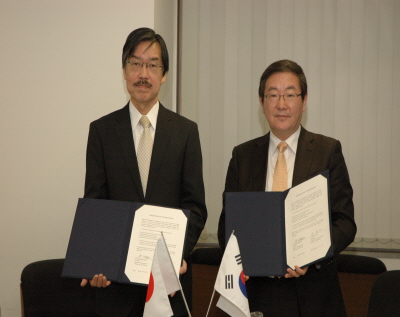
KISTI shook hands with ROIS in Japan
KISTI has concluded MOU with ROIS(Research Organization of Information and Systems) on Feb.6th in Japan. This MoU is to promote exchange of researchers and professors, conduct global research collaboration, organize international conference, share science and technology informaiton. ROIS is research council founded in 2004 in collaboration with NII, ISM, NIG,TRIC,DBCLS,NIPR and is advancing fusion research on the polar regions, telecomunications,statistic mathematics and genetics into world-class level. Dr.Park Young-seo,President of KISTI said that this MoU will establish firm foundation for joint application and dissemination of knowledge information in science and technology and ROIS will wokr as KISTI's global partner in producing value-added information, upgrading reserch environment and commercializing R&D products. -
022012. 02
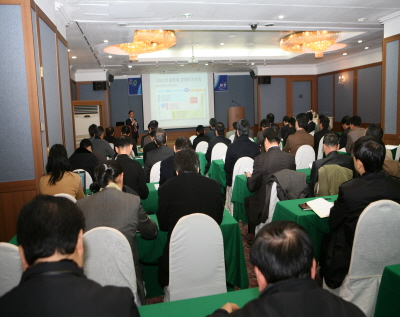
No. 65 View. 23264 The 2011 ASTI CTO meeting in Chungchung Province was held on Jan.12th at Adria Hotel in Yusung. About 50 CTO memebers of Daejeon and Chungchung province were participating in the meeting and shared economic trend and business strategy together with new-year-greetings. Dr. Park has given a lecture to the participants with a title of " 2012 Global economic environment and issues". Dr.Park explained that future technology will be created by merging with new technologies and the influence of SNS will be increased more than ever. He also emphasized that there will be lots of uncertain factors in economic situations this year but we can get over with more active communications and aggressive strategy.
-
182012. 01
No. 64 View. 24365
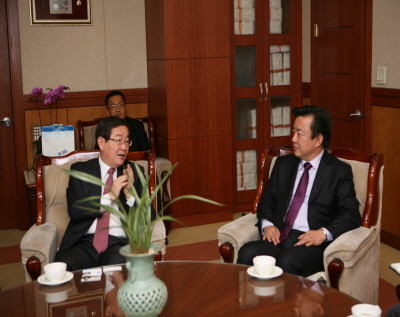
President of ACTS visited KISTI
KISTI has welcomed Mr.Lee Hyo-jeong, President of ACTS(Daejeon Agency of Advanced Cutural Technologies and Service) and his visiting group on Jan.10th at its head office located in Daejeon. ACTS was built as the agency of Daejeon city in 2007 to promote medial industry and cultural events in Daejeon city. Mr.Lee,President of ACTS was given a brief introduction of KISTI R&D activities and had a field trip to KISTI supercomputing center. After that, Dr. Dr.Park Young-seo, President of KISTI and Mr.Lee had a discussion on mutual cooperation for supporitng media industry with KISTI supercomputer. -
062012. 01
No. 63 View. 24298
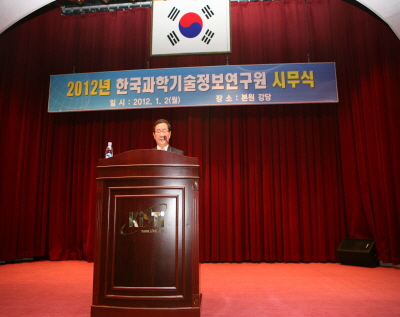
KISTI Kick-off meeting for 2012
KISTI hold a kick-off meeting for 2012 at its head office located in Daejeon. At the meeting, Dr.Park Young-seo,President of KISTI emphasized the importance of year 2012 as KISTI will celebrate its 50th anniversary of its foundation on May 18th. At the speech, Dr.Park appreciated KISTI staffs for their efforts and contribution to the remarkable and excellent R&D performance made in 2011. After the meeting, Dr.Park and executive managers shook hands with every staff participating the meeting wishing the best luck for year 2012. -
042011. 10
No. 62 View. 30930
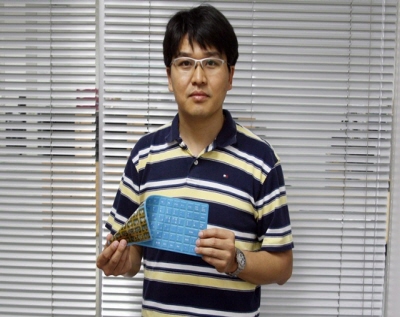
'Having Fun, Relaxing,' Researchers Create Profitable Keyboard
'Having Fun, Relaxing,' Researchers Create Profitable Keyboard The development of a 'power-free, wireless keyboard' was not an official research project of our institute. It was created by chance. "We did not start our project with the intent of developing a power-free, wireless keyboard. In reality, the product's creation simply happened in the course of our enjoying our R&D work. We're excited that we came to transfer the technology in order to come a step closer to its commercialization." Chung Sung-kwan, chief of future device team, KAIST Institute for IT Convergence, develops 'power-free, wireless keyboard technology' 'Ideas' discussed in taskforce meeting lead to 'exciting development' So says Chung Sung-kwan, head of the future device team at the KAIST Institute for Information Technology Convergence(chief Cho Dong-ho), which operates under the KAIST Institute(Director Kim Sang-soo). Chung developed a "power-free, wireless keyboard," which can operate without a power supply and a cord, and successfully transferred the technology to a company, drawing attention from people within and outside the research community. The keyboard is a device that operates wirelessly, even without a built-in power source. Unlike wireless keyboards that are on the market, this device does not require a battery. In order for us to use a computer, diverse peripheral devices are required, including output units such as a monitor and printer, and input devices, such as a keyboard and mouse. Such supplementary devices also include a portable hard disk and USB memory, which are used to increase the user's convenience in data storage. However, all these devices require a cable to supply power. Without a cable, power cannot be supplied and data cannot be stored or moved. So what is the mechanism of the "power-free, wireless keyboard" that has been developed by Chung and his team?The secret lies in RFID(Radio-Frequency IDentification) technology. Using mobile RFID tag technology, the new device allows the computer to recognize the pressing of keys. RFID refers to a technology that allows for remote recognition of data by using electro waves, a process that requires an antenna for data transmission and reception. RFID is commonly used in our daily living. RFID chips are contained in bus and subway public transportation cards, and in the security key buttons in new clothes that prevent shoplifting. Common keyboards contain some 80 to 110 keys. These keys are linked to circuits at the bottom, and whenever keys are pressed, the signs are displayed on the monitor, which is an output device. Both desktop computers and laptops operate through this mechanism. The keys on the power-free, wireless keyboard are the same as those on normal keyboards in the way they are linked to circuits. However, the new keyboard's individual keys, each measuring 2cm, each contain a built-in antenna that transmits data to the keyboard, and a RFID chip. The chip is about 2 mm long and 2mm wide. When a user inputs data through keys on a power-free, wireless keyboard, the keyboard receives the data via a Reader. Upon receiving this data, the Reader sends the signals to the software. At the same time, it constantly scans the data(reading) at speeds of up 10 to 20m/sec. Another characteristic of the power-free, wireless keyboard is "flexibility." Since it uses a film-type polyimide and can be produced in the form of printed circuit boards, it can be rolled and folded, a feature that makes the device easy to carry. Also, since individual keys operate independently, it is possible to use the keyboard even when it is folded, bended, or randomly compressed. Chung Sung-kwan, chief of the KAIST Institute for IT Convergence, who developed the 'power-free, wireless keyboard' Individual rectangles constitute the keys. The dark part functions as an antenna, while the smaller chip on the right is an RFID chip The development was made possible thanks in large part to the support of KAIST professors Cho Dong-ho of the department of electrical and electronic engineering(Director of IT fusion research center) and Yoon Chun-sup from the department of physics. Prof. Cho first suggested the idea of a wireless keyboard and incorporated key recognition technology adopting the RFID method to add to momentum to the device's development. Prof. Yoon examined the structure and physical characteristics of the material used in the keyboard to ensure that data could be communicated even if the keyboard were bended or folded. # 'Ideas on wireless keyboard popped up while chatting' The idea for a power-free, wireless keyboard started with a "story." It is the result of rather uncanny imaginations. The KAIST Institute for IT Convergence runs a "future terminal taskforce," which is comprised of the future device team and professors in related fields. The taskforce was created with a view to examining "things that will have a major impact on the market," and "items that can spearhead technological advance and that users need." The idea popped up when taskforce members were chatting about submissions to a "Contest on future terminal ideas," which the IT Convergence Institute conducted for its researchers in 2007. While running the taskforce, team leader Chung Sung-kwan was carrying out a project entitled "User interface technology concerning future IT device transformation." The objective of the project had nothing to do with the development of the power-free, wireless keyboard. The keyboard was developed while the taskforce was conducting this research project. Whenever they faced obstacles in conducting the project, taskforce members gathered to discuss how to sort things out. A smiling Chung said, "While conducting research projects, we often face situations where we can't effectively address challenges and get headaches." He added, "Whenever we had such problems, we diverted our efforts to focus on the development of the power-free, wireless keyboard to relax and ease our headache and to draw the public's attention." In short, the keyboard was effectively a "fun development," which taskforce members returned to for relaxation whenever they felt bored or developed a headache about their research projects. Chung Sung-kwan conducts a demonstration on his own. Whenever the small keys were pushed, letters were presented on the display. # Transferring technology to a company, developers 'seek to focus on the acquisition of core technology, instead of minimal technology transfer fees' The KAIST institute for IT Convergence transferred the "power-free wireless keyboard technology" via P&IB's Daejeon branch(Kang In-gyu, branch chief) to Hanyang Semitech in Gyeonggi Province on July 18. The contract entailed 30million won in technology transfer fees and 3% of running royalty fees. Chung said, "We developed the keyboard to acquire a core technology at the school, not to transfer technology, and had no intent for technology transfer in the first place." He added, "Rather than focusing on the fact that we transferred the technology, we will seek to address the technology that the company needs and the problems it must resolve when commercializing the transferred technology." Chung plans to continue supporting Hanyang Semitech over the next two years to help commercialize the technology. You Sang-youngyoung at HelloDD.com twitter: at SangYoung25 [August 12, 2010] - - - - - - -Source - HelloDD.com -
042011. 10
No. 61 View. 30224
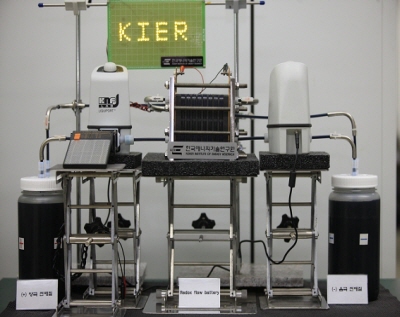
5kW-class 'Redox Flow Battery' Developed
5kW-class 'Redox Flow Battery' Developed Amid growing worldwide attention to large-capacity secondary battery technologies, a Korean research team has developed and successfully demonstrated 5kW-class Redox Flow Battery technology. Core technology developed for production of large-capacity rechargeable batteries A Redox Flow Battery(RFB) is a rechargeable battery that can store energy for an extended period of time by repeating recharge and discharge processes. Theoretically, there is no limit to its lifespan, with longevity known to be more than 10 times that of a lithium-ion battery. The developed device is a new-concept, next-generation battery that can increase the duration of power usage as much as desired according to the battery's capacity. The Korea Institute of Energy Research(Han Moon-hee, President) said on July 15 that it had developed and successfully tested for the first time in Korea 'RFB technology,' which is emerging as the most promising system among large-capacity rechargeable batteries. According to the institute, a demonstrative test found that the battery exhibits a level of output performance on par with that of world-class products, with its efficiency shown to be 5 to 10% higher. The newly developed RFB system is comprised of a stack and an electrolyte tank. The stack, where chemical reactions occur, can be operated at normal temperatures, and thus can be used for over 20 years. It adopts vanadium as its active substance and can be used semi-permanently, thus meeting the conditions of a rechargeable battery in terms of safety, lifespan, and disposal. The development of the new system is significant in that it allows for stable electric power supply(stabilization of output) by addressing problems with the generation system of renewable energy, which could not supply energy in a continuously stable fashion due to being affected by significant output fluctuations tied to the surrounding environment and natural conditions. The RFB system is highly sought after as a promising next-generation energy-storage technology due to the huge potential for its advancement: it can be applied to renewable energy power generation systems, power plants, blackout-free power supply systems in buildings and semiconductor plants, and a power source for unmanned communication sub-stations. When its energy density is increased, it can also be used in electric vehicles. The institute has developed recharging systems for electric vehicles for over 10 years, and has been conducting research and development activities in the large-capacity battery field, encompassing the development of core technology for large-capacity RFB, cultivation of human resources, and consultation for industries. Dr. Jin Chang-soo, principal investigator at the Energy Conversion and Storage Research Center, said, "The achievement is expected to serve as a catalyst for the transition of research in Korea on large capacity rechargeable batteries into the phase of full-fledged technology development." Jin added, "Going forward, the institute will aggressively conduct follow-up studies aimed at optimizing processes and securing enhanced long-term performance in order to assure the durability and economic viability of the battery, which are required for its actual industrialization." ? Kim Joe-sephjoesmy at HelloDD.com twitter: at ssebiU [August 02, 2010] - - - - - - -Source - HelloDD.com